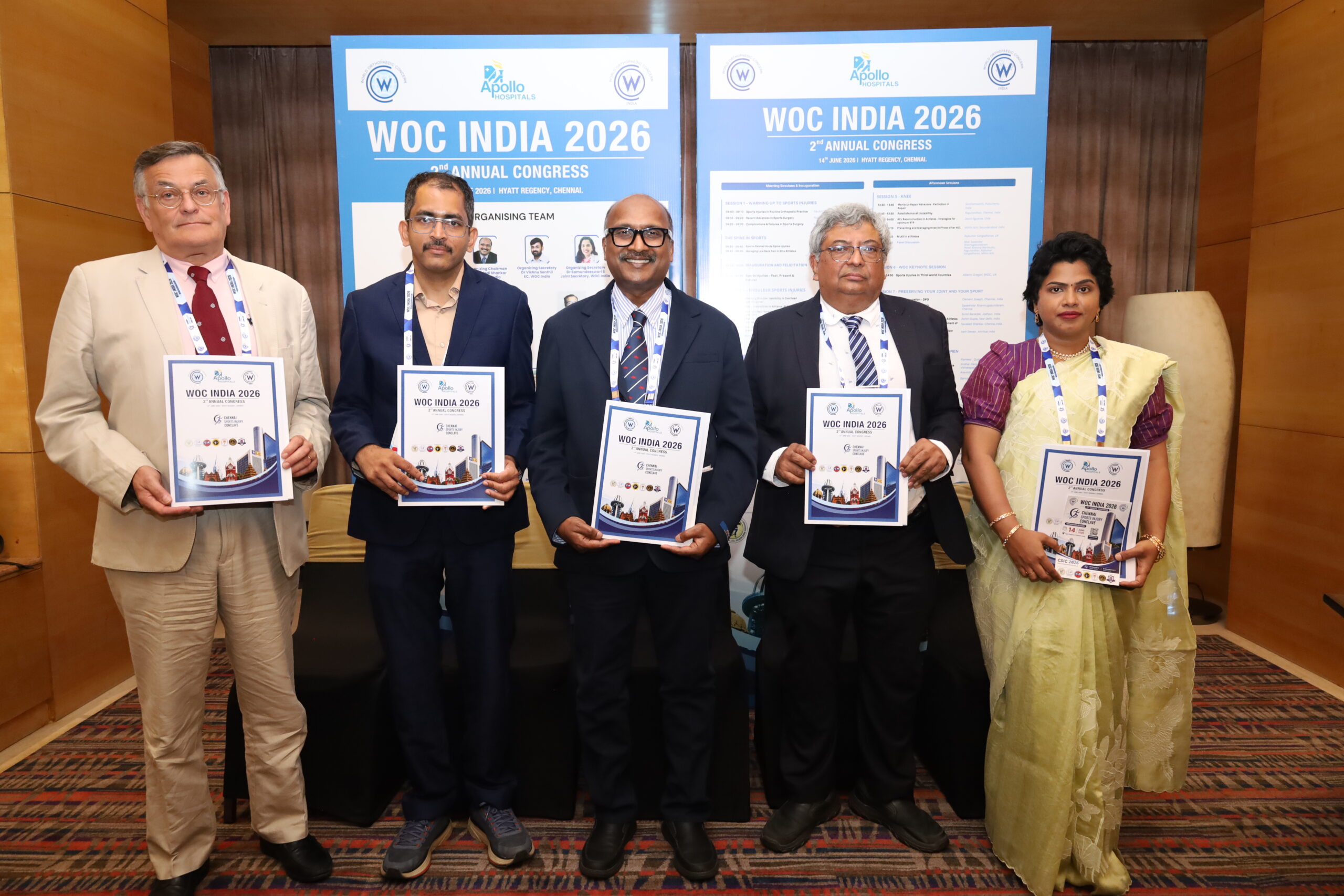
Chennai, June 14, 2026: The India Chapter of the World Orthopaedic Concern, a leading global organisation dedicated to advancing orthopaedic care, in association with Apollo Hospitals, conducted the 2nd Annual Congress WOC India – Chennai Sports Injury Conclave 2026.
The one-day academic event brought together over 250 leading orthopaedic surgeons, sports medicine specialists, clinicians, and healthcare professionals from across the country to deliberate on the latest advances in sports injury prevention, diagnosis, treatment, rehabilitation, and emerging innovations aimed at improving athlete care, performance, and recovery.
The scientific programme featured 35 distinguished national and international faculty members who shared their expertise through scientific sessions, panel discussions, and hands-on workshops. Five dedicated workshops on ACL and multiligament injury reconstruction, meniscal repair, distal femoral osteotomy, high tibial osteotomy, and Platelet-Rich Plasma (PRP) therapy offered participants practical training in advanced techniques and contemporary approaches to sports injury management.
The conclave was attended by several distinguished office-bearers of the World Orthopaedic Concern, including Dr Arindam Banerjee, President, WOC International and WOC India; Dr Chinmay Narh, Honorary Secretary, WOC India; and Dr Sidhant Goyal, Treasurer, WOC India. The event was organised under the leadership of Organising Chairmen Dr Navaladi Shankar, Senior Consultant Orthopaedic Surgeon, Apollo Hospitals, Chennai, Dr Ilankumaran Kaliamoorthy, Chief Executive Officer, Apollo Hospitals Chennai and Dr S. Saseendar, Vice President, WOC India. The Organising Secretaries were Dr Vishnu Senthil, Executive Committee Member, WOC India, and Dr Samundeeswari S, Joint Secretary, WOC India.
In his comments, Dr Arindam Banerjee, said, “India has emerged as a global leader in orthopaedics and sports medicine. We are no longer merely recipients of knowledge and assistance; today, Indian experts are actively training doctors and sharing expertise across the world. With our strong clinical talent, expanding healthcare infrastructure, and vast experience in managing complex musculoskeletal conditions, India is well-positioned as an orthopaedic powerhouse. However, as participation in sports and physical activity continues to grow, so does the incidence of sports-related injuries. It is therefore essential that we continue to expand access to specialised expertise and the latest medical advances across the country. Through this conclave, we aim to create a platform for meaningful face-to-face interactions, expert-led discussions, and case-based learning that will enrich clinical knowledge, strengthen clinical decision-making, and ultimately improve outcomes for athletes and patients alike.”
Dr Navaladi Shankar commented, “This conclave reflects our shared vision of advancing musculoskeletal health through knowledge exchange, innovation, and capacity building. Sports injury management is evolving rapidly, driven by new evidence, emerging technologies, and advances in surgical and non-surgical care. Forums such as this play a vital role in disseminating contemporary knowledge, refining clinical and surgical skills, and fostering multidisciplinary collaboration for better patient outcomes.
The scientific programmes discussed a wide spectrum of topics, including sports injuries in routine orthopaedic practice, recent advances in sports surgery, acute spine injuries in sports, shoulder and elbow instability, ligament reconstruction, joint preservation, cartilage restoration, meniscus repair, arthroplasty, and the management of elite athletes. Emerging areas such as orthobiologics, bone marrow concentrate therapies, and regenerative approaches to athletic injuries were also explored.”
Dr. Saseendar Shanmugasundaram, commented, “Sports injuries are increasing as more people take up sports and physical activity to stay fit. This makes continuous education essential, particularly for young orthopaedic surgeons and postgraduate trainees, to accurately diagnose and effectively manage these injuries. Most sports injuries involve the knee, shoulder, ankle, elbow, and hip, and the field is rapidly evolving with advances in MRI, bioabsorbable implants, regenerative medicine, and orthobiologics such as bone marrow concentrate and PRP. These innovations are improving healing and enabling joint preservation and reconstruction even in complex cases. This conclave helped raise awareness of emerging challenges and equipped clinicians with the latest knowledge and techniques in sports injury management.”
Dr. Samundeeswari Saseendar, commented, “Shoulder injuries are increasingly common in sports such as cricket, badminton, volleyball, and swimming. Persistent pain, instability, or recurrent dislocations should not be ignored. With advances in arthroscopic surgery, biologics, and rehabilitation, most athletes can return safely to sports with excellent outcomes”.