Chennai, November 2026: The 27th International Sericultural Commission Congress (ISCC-2026), the triennial flagship event of the International Sericultural Commission (ISC), an intergovernmental organisation dedicated to the development of sericulture and the global silk industry, commenced in Chennai today, bringing together over 300 scientists, technocrats, policymakers and industry leaders from more than 25 countries.
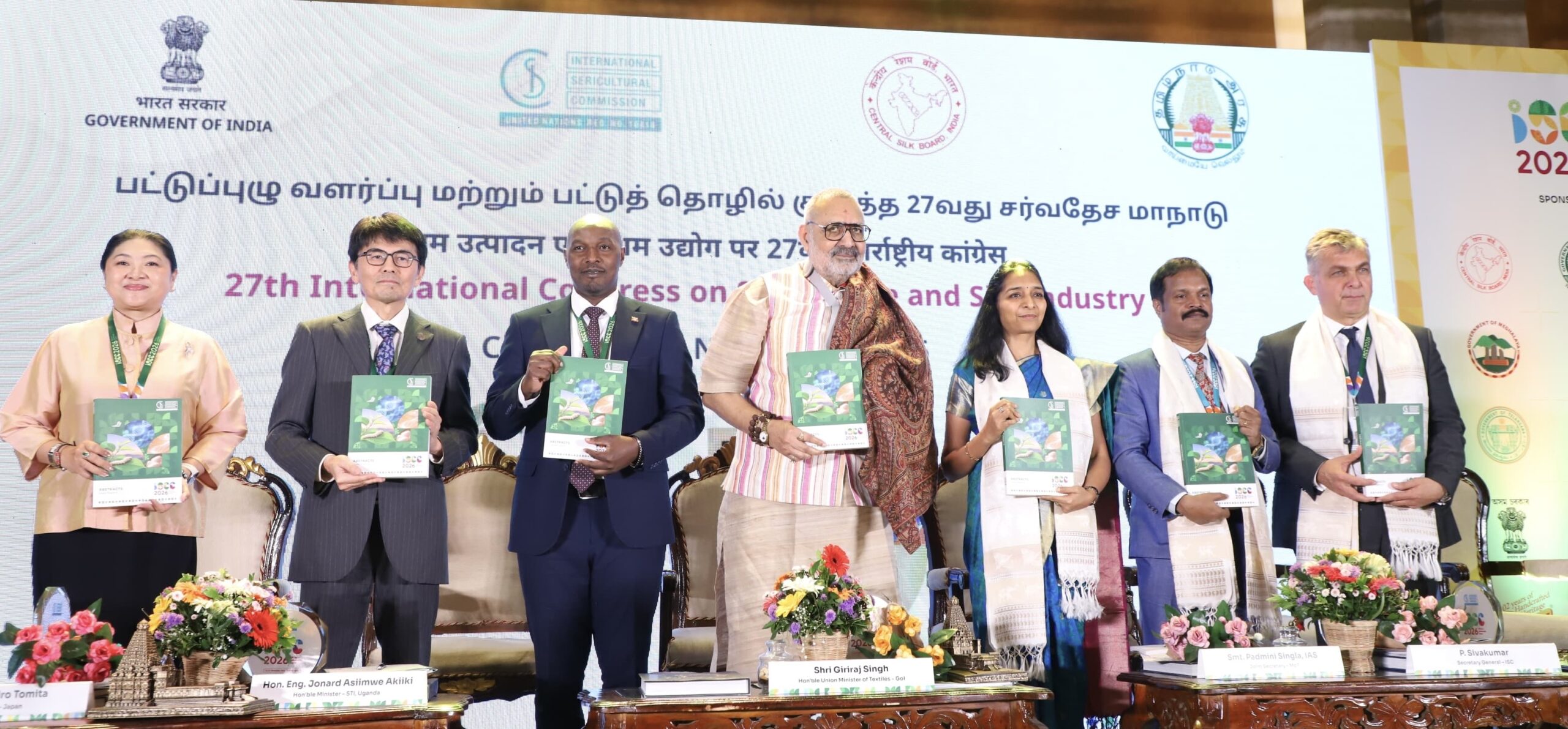
Shri Giriraj Singh, Union Minister of Textiles, Government of India, inaugurated the Congress in the presence of Hon. Eng. Jonard Asiimwe Akiiki, Minister for Science, Technology and Innovation, Uganda; and other international dignitaries.
The five-day global summit, which will continue until November 27, aims to position India as a global bioeconomy hub, influence global sustainability and Life Cycle Assessment (LCA) standards for the sericulture sector while ensuring that they do not create unfair international trade barriers, and establish high-value export linkages for Indian silk reeling mills, spinning units and exporters.
Organised under the theme “Silk for a Sustainable Future”, the Congress will provide an international platform for sharing scientific advancements, exploring emerging technologies, strengthening global partnerships and examining new business opportunities across the sericulture and silk value chain.
The technical sessions will cover a wide range of subjects, including mulberry sericulture, non-mulberry silkworms, Bombyx mori (the domesticated mulberry silkworm), bacology of silkworms, post-cocoon technology, silk processing, trading and marketing, sericulture in non-textile industries, and the global silk economy.
The Congress will highlight India’s transition towards high-grade bivoltine silk (4A/5A+ quality) and demonstrate the country’s capability to produce recombinant and biomaterial-grade protein filaments for international pharmaceutical and technical textile applications. The deliberations will provide India with an opportunity to take a leadership role in shaping emerging international LCA and environmental benchmarks for silk, while ensuring that Indian smallholder production practices are fairly recognised and protected against potential unfair international trade barriers.
The Congress will also facilitate connections between Indian silk reeling mills, spinning units and exporters and foreign technical partners and commercial buyers from the US, Europe and Asia, opening up opportunities for contract manufacturing and the supply of sustainable specialty yarns.
It will serve as a platform for progressive silk farmers, reelers and weavers, particularly from Tamil Nadu, to gain exposure to advanced silkworm-rearing techniques, disease forecasting models and zero-waste approaches to by-product valorisation, including pupal oil production and sericin extraction. Direct access to international experts and exposure to innovations in automatic silk reeling are expected to accelerate the technological upgradation of Tamil Nadu’s expanding bivoltine silk-producing regions, particularly Dharmapuri, Salem, Erode and Coimbatore.
A major highlight of the Congress will be a technical tour to Kanchipuram on November 26, in which around 200 international delegates will participate. The visit is expected to bring unprecedented global visibility to Tamil Nadu’s traditional Korvai weaving artisans, cooperative societies and the Kanchipuram Silk Park, showcasing the region’s rich silk-weaving heritage and capabilities to the international silk industry.
Speaking on the occasion, Mr. P. Sivakumar, Secretary General, International Sericultural Commission, said: “As we convene the 27th Congress in Chennai, under the theme ‘Silk for a Sustainable Future’, our global community stands at a defining crossroads. While silk is intrinsically natural, renewable and biodegradable, recent LCA findings highlight critical environmental hotspots across the value chain, ranging from energy and water consumption to chemical usage in post-cocoon processing.
We cannot take silk’s sustainability for granted. The urgent challenge before us is to develop globally harmonised sustainability standards, accelerate circular, zero-waste technologies, and protect the livelihoods of millions of smallholder farmers and weavers worldwide. This Congress provides an important international platform for bringing together scientists, policymakers and industry stakeholders to deliberate on these challenges, share innovative solutions and chart a collaborative roadmap towards a more sustainable and resilient global silk industry.”