
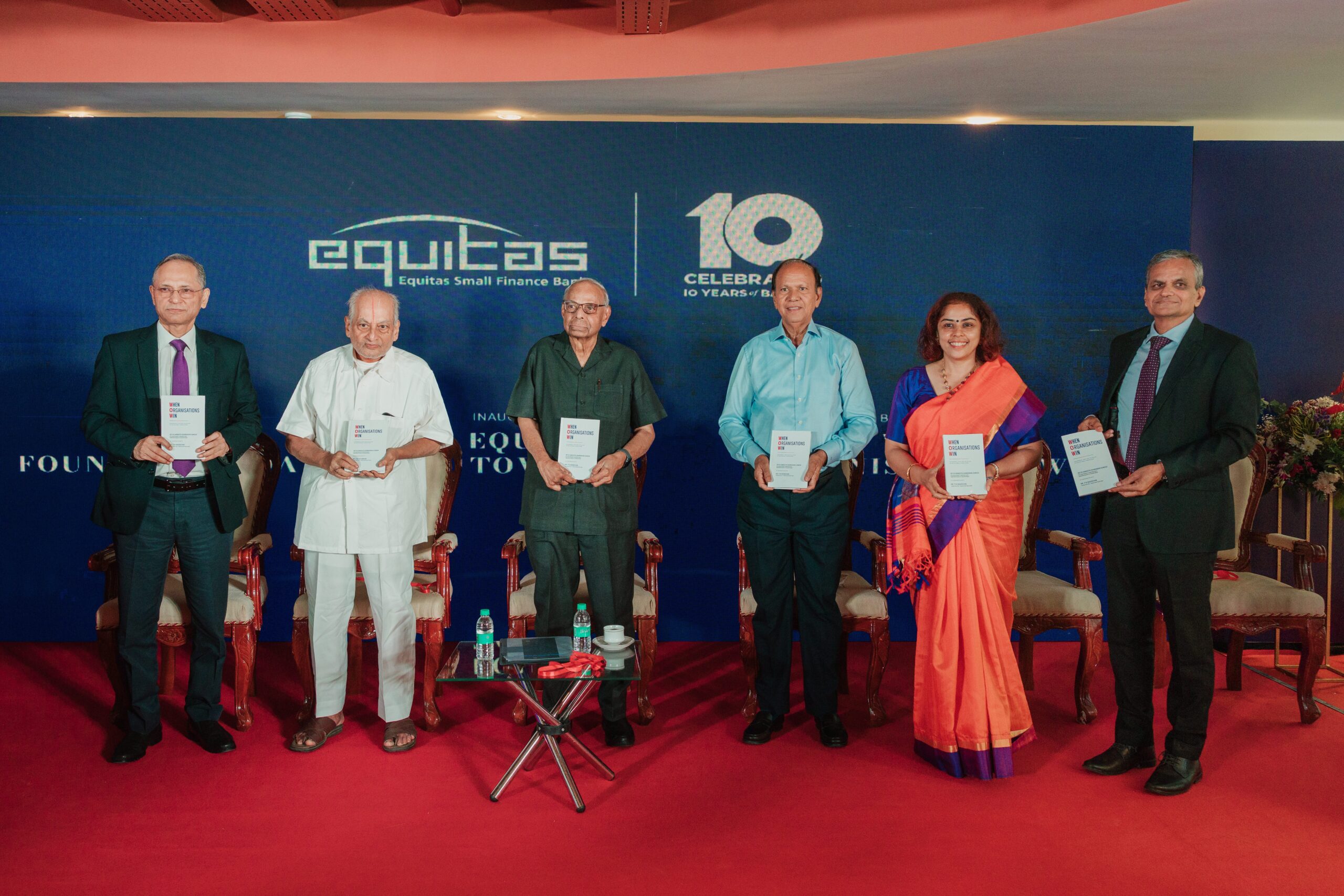
Chennai, September 7, 2026:
Equitas Small Finance Bank today announced the launch of When Organisations Win – Governance, Trust and the Values of Equitas Small Finance Bank, a book that explores what enables organisations to build trust, create sustainable value and remain resilient over the long term.
Authored by Dr CA Sangeeta Shankaran Sumesh, CFO, business and leadership coach, author, speaker and Independent Director, the book takes readers inside the governance journey of Equitas Small Finance Bank through conversations with P N Vasudevan, Managing Director & Founder, Equitas Small Finance Bank.
The book looks beyond governance as a set of rules, regulations and compliance requirements. It explores governance as a way of thinking, behaving and making choices, particularly when organisations face difficult decisions, competing priorities and evolving risks.
At the heart of the book is the Frames Approach to Governance, under which Equitas looks at governance through frames. The approach encourages organisations to identify different frames of governance, work out different action plans under each frame, leading to a dynamic governance model.
The book explores several frames of governance, including Board-management alignment, sensitivity to regulatory signals, communication with the RBI, learning from others’ mistakes, customer-centric governance, business model, credit risk, technology, operational controls, investor relationships, ethical leadership and impact on society.
Through conversations with Vasu, the book also brings alive experiences and decisions from Equitas’ journey, right from its early days as a microfinance institution to its evolution into a Small Finance Bank. It highlights how governance considerations have influenced business decisions along the way.
Speaking about the book, P N Vasudevan, Managing Director & Founder, Equitas Small Finance Bank, said,“Governance is not a destination. It is a continuous journey. As an organisation evolves, its governance framework also needs to evolve. The Frames approach has helped us look at governance from multiple frames and continuously challenge ourselves to do better. We hope to keep evolving our governance model in tune with the changing times”.
When does an organisation win?
The book explores whether winning is simply about growth, profitability and business performance or whether organisational success must also encompass trust, integrity, responsible leadership, customer interest and the ability to create lasting value for society.
According to Dr CA Sangeeta Shankaran Sumesh, Author of When Organisations Win,“My journey with Equitas began with curiosity. Small experiences made me wonder about the governance philosophy behind the organisation. When Equitas invited me to write this book, I saw an opportunity to explore that curiosity more deeply through conversations with Mr Vasudevan and by understanding the Bank’s governance journey. What emerged was a perspective on governance not merely as rules and compliance, but as choices, values and behaviours.
Through this journey, I realised that governance comes alive in the choices an organisation makes, especially when doing the right thing, even when nobody is watching. It is not necessarily the easiest thing to do. When Organisations Win encourages leaders to look at governance through a wider lens and reflect on what it could mean in their own organisations.”
The “WOW” behind When Organisations Win
The idea captures the aspiration behind the book: organisations that create a positive impact and earn the trust of their stakeholders should be capable of making people say “WOW.” And that is possible when the foundations of governance, values, and responsible leadership are consistently chosen.
When Organisations Win is intended for business leaders, Board members, Independent Directors, bankers, investors, students, aspiring leaders and anyone interested in understanding corporate governance beyond compliance.
The Equitas experience is presented as one journey and one approach, intended to stimulate reflection, questioning and learning among organisations and leaders.The book concludes, stating, “The journey does not end here. It continues with every decision, every conversation, and every choice to do the right thing.”